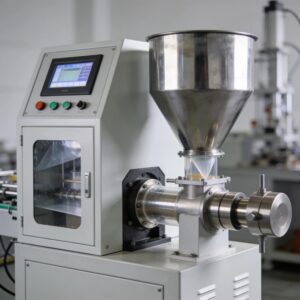
If you are running a plastic recycling business in Accra, Kumasi, or anywhere in Ghana, you have probably faced a very annoying issue during production: your plastic pelletizing machine suddenly stops taking in material. The motor is running, the screw is turning, but the plastic waste just sits in the hopper or dances around the inlet without moving down.
In our local recycling yards, operators often call this “feeding jam” or “bridging.” When your plastic pelletizing machine refuses to take in material, your entire production line grinds to a halt. In Ghana, where electricity tariffs are high and unexpected Dumsor or voltage drops can hit at any time, every minute your machine runs empty is money leaking out of your pocket.
Even worse, leaving the screw spinning without fresh material can cause the remaining plastic inside to burn, creating black spots that ruin your next batch of recycled pellets.
Many factory managers immediately blame the quality of the waste material or assume the screw design is wrong. However, under the actual working conditions in most Ghanaian workshops, feeding failure usually comes down to three common practical reasons.
The first major cause is material bridging at the feed inlet, which happens a lot when you are recycling lightweight materials like crushed LDPE pure water sachets or fluffy PP woven bag flakes. Because these materials are very light and irregular, they easily lock together and form a hollow arch inside the hopper, completely blocking the path to the screw.
The second culprit is high moisture content in your local feedstock. If your workers did not dry the washed plastic scraps completely under the sun or in the dryer before dumping them into the plastic pelletizing machine, the extreme heat inside the throat will instantly turn that moisture into a massive amount of steam. This upward steam pressure acts like an invisible wall, pushing back against the incoming material and stopping it from dropping down.
The third reason is a phenomenon called “throat melting,” where the temperature around the feed zone is set way too high. When the inlet area gets too hot, the incoming cold plastic flakes melt prematurely right at the entrance, sticking to the screw flights and creating a slippery plastic ring that seals off the channel.
To get your plastic pelletizing machine swallowing material smoothly again, start by breaking the physical blockage inside the hopper. For factories processing light films and sachet bags, having workers push the material down with sticks is dangerous and inefficient.
The better solution is to install a mechanical forced feeding device or a screw stuffer on top of the feed inlet. It constantly forces the lightweight flakes down into the screw flights, giving you a steady and continuous material flow.
If you are running a basic setup without a stuffer, have operators feed the material in smaller, consistent portions rather than dumping huge piles into the hopper all at once.
If you see steam rising out of the feed throat and the material bouncing around, deal with the water content first. Stop feeding wet material and route the washed scraps through a heavy-duty centrifugal dewatering machine before they reach the hopper.
In many Ghanaian yards, relying only on sun drying can be tricky during the rainy season, so introducing a mechanical drying silo right before the hopper will save you a lot of downtime.
Once the material is dry, the steam pressure disappears and the dry flakes drop into the barrel under their own weight.
When feed-throat melting — premature melting of the material right at the inlet — is causing the feeding jam, the problem is heat building up in the feed zone. There are two separate levers to pull, and it helps to treat them as distinct checks.
First, the temperature settings. Lower the setting on the very first heating zone, which sits just downstream of the throat and conducts heat back up into the feed area. Adjust it in steps and watch the result — dropping it too far risks a different kind of plug, where solid flakes jam instead of melting.
Second, the throat’s own cooling. The feed throat is kept cool by a water jacket, not by a heater, and in dusty Ghanaian workshops the cooling pipes often clog with mud or hard-water scale over time. Check the water jacket, and if the flow looks weak, have your mechanic flush the cooling channel. If you use a descaling agent, check the throat material first — it is often an aluminum casting, which strong acid descalers will attack — then dilute it to spec and flush the channel through with plenty of clean water afterwards. What you want is a steady cold-water circulation that keeps the throat cool enough that the plastic only starts melting further down the barrel.
By adjusting your feeding setup, controlling feedstock moisture, and keeping your cooling channels clean, you can completely eliminate feeding stoppages on your plastic pelletizing machine. This keeps your daily production targets on track, ensures your output pellets stay clean and premium, and protects your business from wasting expensive factory electricity on an empty machine.
How to Fix Plastic P
Troubleshooting a Su