
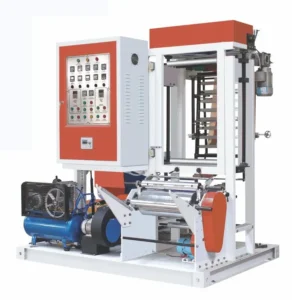
A bubble that keeps snapping just above the die head is one of the fastest ways to lose a shift in Tema, Accra, or Kumasi. Each blowout stops the line, sends operators up the tower to re-string the web, dumps purged resin, and burns ECG power while the machine climbs back to speed. Two or three in a shift turns a profitable run into a loss.
Unlike a tear near the nip rollers, a rupture at the die exit means the polymer is failing where it is weakest. Between the lip and the frost line the resin is molten and holding internal air pressure, so a steam pocket, a carbon speck, or a sudden loss of melt strength will open the curtain before it has a chance to cool.
Ruptures rarely happen at random. In local plants they trace back to four causes.
Moisture in washed regrind is the most common. In the rainy season, or when the plant runs locally washed sachet and bottle scrap, water stays inside the pellet. At barrel temperature it flashes to steam, and those bubbles reach the die gap inside a thin molten wall, where they open and tear under inflation pressure.
Carbon buildup is the second, and power cuts are what create it. When an outage stops the extruder while it is hot and full of resin, static plastic cooks in the die channels and carbonises onto the steel. Restart without purging and that deposit breaks loose and drags through the gap.
Runny melt is the third. Pushing barrel and die temperatures up to squeeze extra kilos per hour degrades the chains, and a melt that is too fluid will not hold the bubble — it sags and tears just above the lip.
Unmelted contamination is the fourth. Sand, paper fibre, or higher-melting plastic that survives the screen pack lodges in the die gap and splits the curtain continuously until it is cleared.
Before adjusting anything, look at where and how the bubble fails — the pattern identifies the cause faster than any gauge.
A rupture that always opens at the same angle around the die points to that spot: a carbon deposit, a scratched lip, or an air ring that is not delivering evenly at that position. A break that wanders around the circumference is a melt-strength problem, which means temperature, air supply, or resin consistency. A tear accompanied by a scatter of small pinholes is moisture. A continuous longitudinal split running up from the lip is contamination stuck in the gap.
Most local lines run without a hopper dryer, so moisture control has to start upstream. Spin-dry washed regrind and let it air before bagging, keep sacks off the damp floor, and do not leave bags open near a doorway on humid nights. Where the budget allows, a hopper dryer is the cheapest insurance the plant can buy against steam rupture.
At the breaker plate, move to a multi-layer stainless screen pack — 80/100/120 mesh — so grit and gels are removed before they reach the die rather than after they have split a bubble.
Restart discipline after an outage matters more than any setting. Bring the barrel and die zones back to full temperature and hold a 10 to 15 minute heat soak before turning the main drive, then run the screw slowly and purge until clean melt flows evenly at every point around the gap. Purge into a metal tray rather than onto the floor: melt at processing temperature causes burns and leaves a surface nobody should be walking on. Anyone working at the die wears heat-resistant gloves and a face shield.
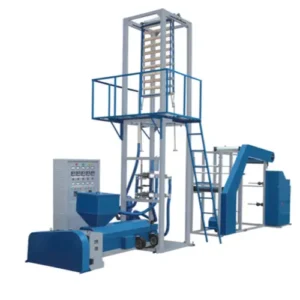
Re-stringing the bubble is tower work. Use the platform and its guard rail, never do it alone, and never climb with hot surfaces exposed.
Clean the lip during a controlled stop, after purging with a small batch of virgin LDPE or a CaCO₃ masterbatch to push degraded material out of the channels. Wipe with a soft brass or copper scraper — never steel knives, screwdrivers, or emery cloth, because a hairline scratch collects burnt resin and turns into a permanent split line. Work from the side rather than leaning over the die, with gloves and a face shield, and isolate the heater circuits before touching a thermocouple.
Verify temperature with a needle probe in the melt instead of trusting the controller. During grid fluctuations the displayed value and the actual heater output can disagree by enough to cook the resin quietly.
Then check the air ring. It should sit level and should not blast cold air directly onto the steel lip, which chills one side of the melt while the opposite side stays weak. A ring that is dirty or uneven produces exactly the fixed-angle rupture described above.
On a single-layer line running 70 to 80 percent local regrind, plants often blend 15 to 20 percent imported virgin LLDPE just to give the melt backbone at the die exit — expensive resin spread through the whole thickness.
An ABA or three-layer structure puts that virgin resin only in the skins, where melt strength at the lip and seal performance are decided, and keeps regrind in the core. It does not make weak resin strong; it stops weak resin from being in the layer that has to hold the bubble.
Screen changers help with contamination, not with moisture or heat. A hydraulic unit lets the pack be changed without dropping the bubble, which suits dirty scrap. Service it with the hydraulic circuit vented and the melt isolated — stored pressure in a changer is a hazard, and hot melt under pressure does not splash politely.
Dry regrind, fine screens, a disciplined restart, a clean lip, verified melt temperature, and an even air ring. Those six keep a bubble up at the die lip on local resin.
If your shift supervisors are losing hours to die-lip blowouts, or you are specifying lines and screen changers for high-regrind production in Ghana, our engineering team would be glad to review your resin blend and setup.
How to Produce High-
How to Fix Film Bloc

How to Fix Hard Band
How to Eliminate Gel