
In Ghana’s packaging sector, margin is decided by two numbers: what resin costs and how much of the output gets rejected. Whether the plant supplies 500ml sachet rolls to bottlers in Accra, refuse sacks in Tema, or carrier bags for traders in Kumasi, one batch that bursts at the seal or splits along the side seam can take a month’s profit with it. With imported virgin resin priced by exchange rate and duty, every manager wants more locally reprocessed granule in the blend without losing toughness.
Getting there is rarely about buying additives. Most weak film comes from orientation, heat history, and what the regrind actually contains.
Thicker film does not fix tearing. It consumes more resin and still splits, because the polymer structure is the problem, not the gauge.
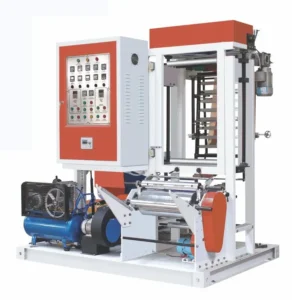
Start with orientation. Tough polyethylene needs chains stretched both along the machine direction and across it. A narrow bubble run at maximum haul-off on a standard PE plastic blown film machine aligns the chains in one direction only: the film pulls hard end to end and tears like paper from the smallest edge nick, which is exactly how a sachet bursts along the vertical seal.
Heat history is the second cause. Heater bands that overshoot during voltage swings, or operators who raise barrel temperatures to force a faster melt, push the polymer past what it will tolerate. Long chains break into short ones and the film loses the elasticity that made it strong in the first place.
Then there is the regrind itself, and this is where most plants skip the checks that matter. Locally sourced recycled granule rarely comes with lab data, and its melt flow index (MFI) drifts from batch to batch depending on whether it came from rigid crates, blow-molded bottles, or film scrap. Blending a high-MFI regrind with a low-MFI virgin resin gives uneven flow and weak bands in the film. Instead of dumping all regrind into one pile, separate batches by source and run a quick melt-flow check at a fixed temperature before mixing them into your main hopper.
Contamination is the third. Unmelted specks and gels are weak points and print defects at the same time, and a finer screen pack on the extruder removes more of them before they become a tear.
Moisture is the fourth, and the cheapest to fix. Regrind absorbs water from the air and from washing, and undried granule produces micro-voids that show up as pinholes and as failure points at the seal. Dry it before it goes into the hopper.
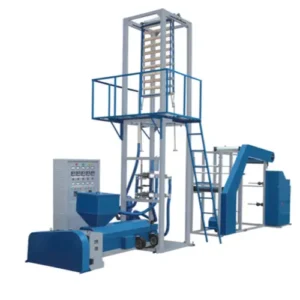
The cheapest strength comes from how an existing HDPE/LDPE plastic blown film machine is run.
Widen the bubble and moderate the pull. Blow-up ratio in the 2.2:1 to 2.8:1 range suits standard LDPE and LLDPE blends; a wider bubble forces crosswise orientation and raises dart impact and puncture resistance without extra resin.
Control the frost line for a 35°C floor. Air ring cooling is less effective in Ghana’s ambient heat, so a frost line that sits too high lets the bubble sag and stretch unevenly, while one that forms too close to the die leaves stress in the film. Clean the air ring, confirm the chiller water is genuinely cold, and balance blower output until the frost line sits level all the way round.
Bring barrel temperatures down. A melt that runs smoky, discoloured, or too fluid at the die is being cooked. Step the rear and middle zones down 5 to 10°C and find the lowest stable profile that still gives a smooth melt — which matters more with regrind than with virgin resin.
Work on the die and the heaters with heat-resistant gloves and a face shield, isolate the heater circuits before touching a thermocouple, and never stand square in front of an open die.
On a single-layer extruder, pushing 70 to 80 percent local regrind usually produces rough surfaces, pinholes, and seals that will not hold, and the plant compensates by blending expensive virgin LLDPE through the whole batch.
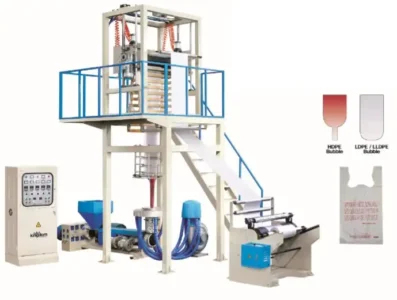
An ABA co-extrusion plastic blown film machine or a three-layer co-extrusion plastic blown film machine changes where the money sits. Virgin resin goes into the skins, where seal strength, gloss, and tear resistance are decided; regrind and filler go into the core, where they add bulk and stiffness. Co-extrusion does not make weak resin strong — it stops weak resin from being in the layer that has to survive a drop test.
Calcium carbonate belongs in that discussion with its cost stated plainly. It lowers resin consumption and raises stiffness, and at high loading it also lowers elongation and impact resistance and can compromise seal integrity if it reaches the skins. Dose it to what the specification allows and verify the result rather than assuming bulk is free.
Feed filler and regrind with dust extraction and a mask at the hopper. Calcium carbonate dust is a respiratory irritant, and a plant that saves on resin while ignoring the hopper is trading one cost for another.
Adjustments without measurement are guesses. Keep a control roll from the previous recipe and test both on the same day. On the shop floor, compare both rolls using a filled-sachet drop test, a manual tear check both along and across the web, and a firm hand-pull across the heat seal. If your plant runs an in-house lab, verify the numbers with dart impact (ASTM D1709) for puncture, Elmendorf tear in both directions (ASTM D1922) for sachet split resistance, and tensile testing (ASTM D882) for elongation.
Then track the reject rate at the sealing line for a week. If the physical tests improve and the reject rate falls, the change was real; if only the machine settings changed, it was not.
Orientation, heat, melt index, filtration, dryness, and layer placement — those six decide whether local regrind makes strong film or expensive scrap.
If your plant is weighing an ABA line or a heavy-duty bag plastic blown film machine against higher virgin resin content, or specifying equipment built to handle Ghana’s ambient heat and voltage fluctuations, our technical team would be glad to review your setup.
How to Fix Film Bloc

How to Fix Hard Band
How to Eliminate Gel
How to Fix Uneven Fi