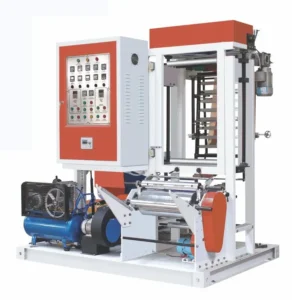
How to Fix Die Lines and Surface Scratches in Blown Film Extrusion: A Practical Guide for Ghana Factories
A fresh roll covered in long, continuous lines is one of the more expensive sights on a blown film line. On the floor they are called die lines, drag marks, or scratches, and they read as cosmetic until the film reaches a customer. On a sachet filling line in Accra, a bag cutter in Kumasi, or a press in Tema, a continuous groove is a built-in tear line and an inkless white streak across the logo.
Knowing where the film is being scored — inside the die head or up on the tower — decides which of two very different fixes applies.
Die Lines vs Mechanical Scratches: Where the Film Is Being Scored
A die line forms at the die exit, before the polymer has cooled. It appears as a smooth, continuous ridge or groove that holds the same angular position relative to the die body, and it comes from carbon, burnt resin, or debris sitting in the narrow die gap.
A mechanical scratch happens higher up, after the bubble has solidified. It looks rougher, more scuffed, and its position follows whatever the web is dragging against — a dirty idler, a worn frame, a rough collapsing slat.
Confirm which one you have by taking two samples: one just above the frost line and one at the winder. If the line is present in both, it is coming out of the die. If it only appears at the winder, something on the tower is marking the film.
Harmattan Dust, Regrind, and Wax Build-Up on the Tower
Two local conditions make surface defects routine in Ghana.
The first is regrind. High ratios of locally washed post-consumer scrap carry sand, paper fibre, and degraded polymer, and anything the screen pack misses flows through the die gap, splits around the particle, and cuts a groove into everything downstream of it.
The second is the Harmattan season. Fine dust settles on the tower and mixes with migrating slip-agent wax and low-molecular-weight polymer on the idlers. The mixture hardens into an abrasive paste that grinds a frosted track into the web — a defect that costs nothing to prevent and a full day to trace if nobody is looking for it.
Cleaning the Die Gap, Filtration, and Tower Inspection Without Damage
Clear a die obstruction without overheating. Raising barrel and die temperatures by 15°C to chase debris only cooks high-regrind melt further and bakes more carbon onto the lip. Feed a small batch of high-melt-index virgin LDPE, or a CaCO₃ masterbatch, at normal running temperature and let it flush the debris out.
If purging does not clear it, stop the line and cool the die to a temperature that can be worked safely, then clean the gap with a soft brass or copper scraper. Heat-resistant gloves and a face shield, working from the side rather than leaning over the lip. Never hardened steel, knife blades, or emery cloth: one hairline scratch on the lip becomes a permanent die line, and with die polishing capacity scarce locally, a gouged lip usually means weeks of waiting on an overseas replacement.
Upgrade filtration before the breaker plate. A coarse support screen backed by 100 and 120 mesh stainless steel stops most of the grit that would otherwise reach the gap, and the pack should be changed on melt pressure trend rather than after a line appears.
Then walk the tower — with the line stopped, the drive isolated, and the machine locked out before any roller is turned by hand. Check every idler for stiff bearings and worn surfaces, and wipe nip rollers, guide bars, and collapsing frames with a clean cloth and a mild solvent, wearing gloves in a ventilated area with no ignition source nearby. Rough or grooved wooden slats can be covered with smooth PTFE tape, or replaced with free-spinning aluminium rollers, so the bubble glides instead of rubbing.
Co-Extrusion: What It Actually Fixes on a Scratched Surface
Single-layer lines running high local regrind tend to lose gloss and clog filters, which is why plants look at ABA and three-layer structures.
What co-extrusion actually does is relocate the problem. Clean virgin resin in the skins gives a smoother, glossier print surface that takes ink evenly, and abrasive regrind in the core puts its grooves on the inner surface instead of the printed one.
That trade needs stating honestly: the inner surface is the seal surface on a bag, so a defect moved inward has not disappeared, it has changed which customer complaint it produces. Test seal strength on the co-extruded structure before assuming the problem is solved.
Co-extrusion also does not stop die lines caused by carbon on the outer lip. That remains a cleaning and temperature discipline job on any die.
Screen changers belong in this section with a caution attached. A hydraulic changer indexes under melt pressure by design, but the screen pack itself is changed in the isolated position — never open a filter housing on a pressurised, hot melt circuit. Vent the hydraulics, isolate the melt, and let the pack cool before it is handled.
Two samples, fine screens, a clean lip, a dust-free tower, and honest expectations from co-extrusion. That is what keeps a printed roll free of streaks in Ghana’s dust season.
If your plant is losing orders to streaks, torn seals, or print defects traced back to local regrind, our technical team can review your line and help you set up an extrusion process that holds up in Ghanaian conditions.